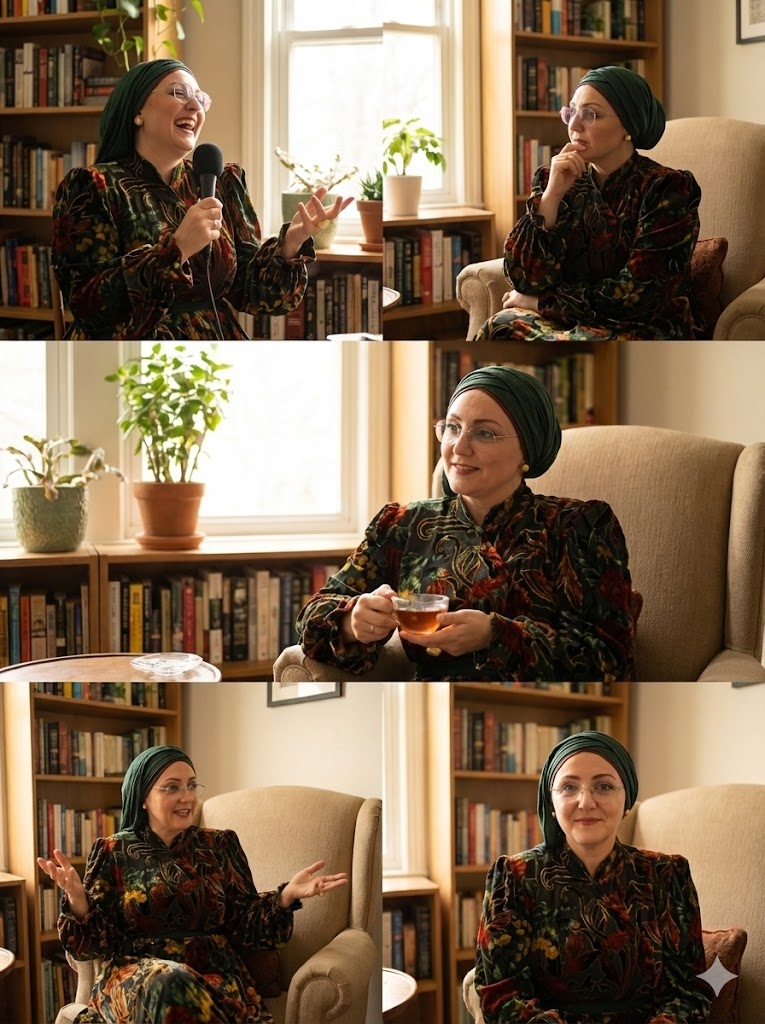
I spent five years as a journalist in North Macedonia. Print, broadcast, features, breaking news. I walked into courtrooms, political offices, refugee facilities, corporate boardrooms, and village halls — always as the person who was supposed to be asking the questions, never as the one with the answers.
That experience gave me a set of leadership skills that I've never once seen on a business school curriculum. And I believe it's why I lead the way I do today.
Skill 1: Reading a room before you open your mouth
A journalist who doesn't read the room misses the story. You learn to scan the energy before you speak. Who's tense? Who's performing for the camera? Who's the real decision-maker in this room, regardless of the official title? What is everyone pretending is fine that obviously isn't?
Leaders who skip this step speak into rooms they haven't read — and wonder why their words land differently than they expected. Room-reading isn't intuition. It's a learned, practiced discipline.
The most important thing a journalist learns isn't how to ask questions. It's how to listen in the silence between the answers.
— Suada CerkeziSkill 2: The courage to ask the question no one else will
In every interview, every press conference, every interview in a difficult environment, there is always one question that is sitting in the room that nobody will ask. The question that gets to the actual truth. The question that might cause discomfort, friction, or even anger.
Journalists ask it. Or they don't do journalism.
Leaders avoid it constantly. They soften it, defer it, ask an easier adjacent question, hope someone else will raise it. The result: rooms full of intelligent people dancing around the actual issue while everyone pretends the conversation is going somewhere.
After five years of journalism, the threshold for asking the question everyone is avoiding is permanently lower for me. It's one of the most useful things it gave me as a leader.
Skill 3: Building trust in 90 seconds with a stranger
There is no such thing as a "warm relationship" in field journalism. You walk in cold. You have a narrow window. And you need enough trust that a person who has never met you will tell you something real.
This sharpens something most leadership development misses entirely: the specific behaviors that generate trust quickly. Eye contact that communicates genuine interest rather than evaluation. Questions that demonstrate you've done your homework. Acknowledging what you don't know rather than projecting false competence. The willingness to be uncomfortable rather than performing ease.
The journalist's trust framework: Show up prepared. Lead with genuine curiosity, not agenda. Ask what they think before you tell them what you think. Acknowledge the difficulty of what you're asking. Tell the truth about what you don't know.
These behaviors work in journalism. They also work in leadership. Every time.
Skill 4: Translating complexity without dumbing it down
A journalist covering a financial crisis, a political coup, or a public health emergency has to translate enormously complex reality for an audience that doesn't have the specialist's context. The work is making it clear, not making it simple. Making it accessible, not making it condescending.
Leaders struggle with this constantly. The subject matter expert who can't explain their own area to non-experts. The executive who presents strategy at a level that only makes sense if you're already inside the room. The manager who gives feedback that's so qualified and contextualized that nobody knows what they're actually being told.
Journalism is a five-year course in the discipline of clarity. I've never stopped being grateful for it.
Skill 5: Staying present when the room is hostile
Not every interview goes well. Some rooms are hostile. Some people don't want to be there. Some situations involve real tension, real anger, real stakes.
A journalist who falls apart when the room gets hard is a journalist who misses the most important stories. You learn to stay present, regulated, and curious — not because you aren't affected, but because the work requires it of you.
This maps directly to leadership. The meetings that matter most are often the most uncomfortable. The conversations that change things are the ones where the room is difficult. The leaders who make the difference are the ones who can be fully present when everyone else is managing the discomfort.
Enjoying this?
Every Thursday I send one leadership insight like this — directly to your inbox. Free.
No spam. Unsubscribe anytime.
What this means for how you lead
I'm not suggesting everyone needs to go be a journalist. I'm suggesting that the disciplines journalism forces — room-reading, courageous questioning, fast trust-building, radical clarity, regulated presence under pressure — are learnable. They're not gifts. They're skills.
Most leadership development focuses on frameworks, models, and concepts. Very little of it forces you into the specific, uncomfortable practice of building trust with strangers, asking the question no one will ask, or staying present when the room wants to push you out.
That's the gap I'm trying to close with the work I do at Arcana. Not another framework. The actual practice.
- Practice reading a room before you speak in it. Spend 60 seconds at the door scanning before you walk fully in.
- In your next meeting, notice the question that nobody is asking. Then ask it.
- Build your fast-trust toolkit: preparation signals, genuine questions, acknowledged limitations.
- Identify one place in your communication where you're making it complex when it needs to be clear.
- Next time the room gets uncomfortable, try sitting in it rather than managing it.
These aren't revolutionary. They're just honest. The leadership development worth doing always is.